How to Teach Geometry to Kids: Angles, Shapes, and Lines
Oh My Homeschool·
A child exploring geometric shapes with colorful blocks
Geometry is the branch of math that children can literally see and touch everywhere — the rectangle of a door, the triangle on a yield sign, the angles formed when they open a book. Yet for many kids, geometry class feels abstract and disconnected from reality. The shapes they could identify at age four suddenly become confusing when terms like "supplementary angles" and "parallel lines" enter the picture.
The key to teaching geometry well is building a bridge between what children already notice about the world and the formal mathematical language they need to learn. This guide walks you through how to do that, grade by grade, from naming basic shapes in kindergarten to measuring and classifying angles in middle school.
Why Geometry Matters
Geometry isn't just another topic to check off — it builds skills that transfer across every subject:
Spatial reasoning — understanding how objects relate in space (critical for science, art, engineering)
Logical thinking — geometric proofs develop the same reasoning used in writing arguments
Real-world math — area, perimeter, volume, and measurement all live in geometry
Visual literacy — reading maps, charts, blueprints, and diagrams
Children who struggle with geometry often struggle with fractions (visualizing parts of a whole), measurement, and later with algebra (graphing on coordinate planes). Building a strong geometry foundation pays dividends across all of math.
The Geometry Learning Progression
Geometry skills build across grade levels in a predictable pattern:
Grade
Key Concepts
geometryshapesgrade 4grade 5math worksheetshomeschool math
Name and describe basic 2D shapes (circle, square, triangle, rectangle)
2–3
Identify attributes (sides, vertices, angles), recognize 3D shapes, understand symmetry
4–5
Classify angles (acute, right, obtuse), measure angles with a protractor, identify parallel and perpendicular lines
6–7
Calculate area and perimeter, understand coordinate geometry, work with transformations
8
Apply the Pythagorean theorem, work with volume, understand congruence and similarity
Teaching Shapes (Grades K–3)
Kindergarten: Naming and Describing
At this stage, children learn to identify the four basic shapes and describe them using everyday language.
What works:
Shape hunts — walk around the house or neighborhood and find shapes everywhere. "The window is a rectangle. The clock is a circle. The roof is a triangle."
Sorting activities — give your child a pile of cut-out shapes and have them sort by type, then by size, then by color
Building — use pattern blocks, tangrams, or simple construction paper to build pictures using shapes
Common mistake: Don't always show shapes in the "standard" position. Children who only see triangles pointing up may not recognize a triangle that points sideways or down. Rotate shapes regularly.
For hands-on practice, try our shapes worksheets designed for kindergarten through grade 3.
Grades 2–3: Attributes and Symmetry
Students working with geometric shapes in a classroom
Now children move beyond naming to analyzing. They count sides and vertices, identify right angles, and explore symmetry.
Key activities:
Attribute sorting — "Put all the shapes with exactly 4 sides here, and all the shapes with more than 4 sides there"
Right angle detector — fold a piece of paper to create a right angle, then use it to "test" angles around the room
Symmetry folding — fold shapes in half to test for lines of symmetry. Which letters of the alphabet are symmetrical?
Geoboards — stretch rubber bands on a geoboard to create shapes with specific attributes ("Make a shape with 4 sides and exactly 2 right angles")
Teaching Angles (Grades 4–8)
This is where geometry gets exciting — and where many students start to struggle. The transition from "shapes have angles" to "angles have specific measurements" is a conceptual leap that needs careful scaffolding.
Grade 4–5: Classifying and Measuring Angles
Step 1: Build the vocabulary
Before measuring anything, children need to understand what angles are and how to classify them:
Angle Type
Degrees
Visual Cue
Acute
Less than 90°
Looks "sharp" or "pointy"
Right
Exactly 90°
Makes an "L" shape, like a corner
Obtuse
Between 90° and 180°
Looks "wide" or "open"
Straight
Exactly 180°
A flat line
Activity: The Body Angle Game
Have your child make angles with their arms:
Arms straight out to the sides = 180° (straight angle)
One arm up, one to the side = 90° (right angle)
Arms close together = acute angle
Arms wide apart = obtuse angle
Step 2: Introduce the protractor
The protractor is the first serious math tool many children encounter, and it's genuinely confusing — two scales, a center point, a curved edge. Take time to teach it properly:
Place the center point on the vertex of the angle
Align the baseline with one ray of the angle
Read the scale where the other ray crosses — use the scale that starts at 0 on your baseline
Step 3: Practice with worksheets
Once children can classify and measure, they need repetition to build fluency. Our geometry worksheets cover grades 4 through 8 with angle classification and measurement problems at progressive difficulty levels.
Grade 6–7: Lines, Relationships, and Area
At this level, geometry expands to include:
Parallel and perpendicular lines — lines that never cross vs. lines that cross at right angles
Complementary angles (sum to 90°) and supplementary angles (sum to 180°)
Area and perimeter of complex shapes (combining rectangles, triangles)
Coordinate geometry — plotting points and identifying shapes on a coordinate plane
Teaching tip: Complementary vs. supplementary is a common mix-up. Use this mnemonic: Complementary = Corner (90°), Supplementary = Straight (180°).
The Pythagorean theorem is best taught with actual squares. Cut out three squares from graph paper — 3×3, 4×4, and 5×5. Show that the area of the two smaller squares (9 + 16 = 25) equals the area of the largest square. Then physically arrange them on the sides of a right triangle.
5 Hands-On Geometry Activities
1. Shape Scavenger Hunt (All grades)
Create a checklist: circle, triangle, rectangle, square, hexagon, parallel lines, right angle, symmetrical object. Walk through the house or neighborhood and check off each item. For older kids, add: acute angle, obtuse angle, perpendicular lines.
2. Angle Estimation Game (Grades 4+)
Draw an angle on the whiteboard. Everyone estimates the measurement, writes it down, then measure with a protractor. Closest estimate wins. This builds angle sense — the ability to "feel" how big an angle is without measuring.
3. Tangram Puzzles (Grades 2–6)
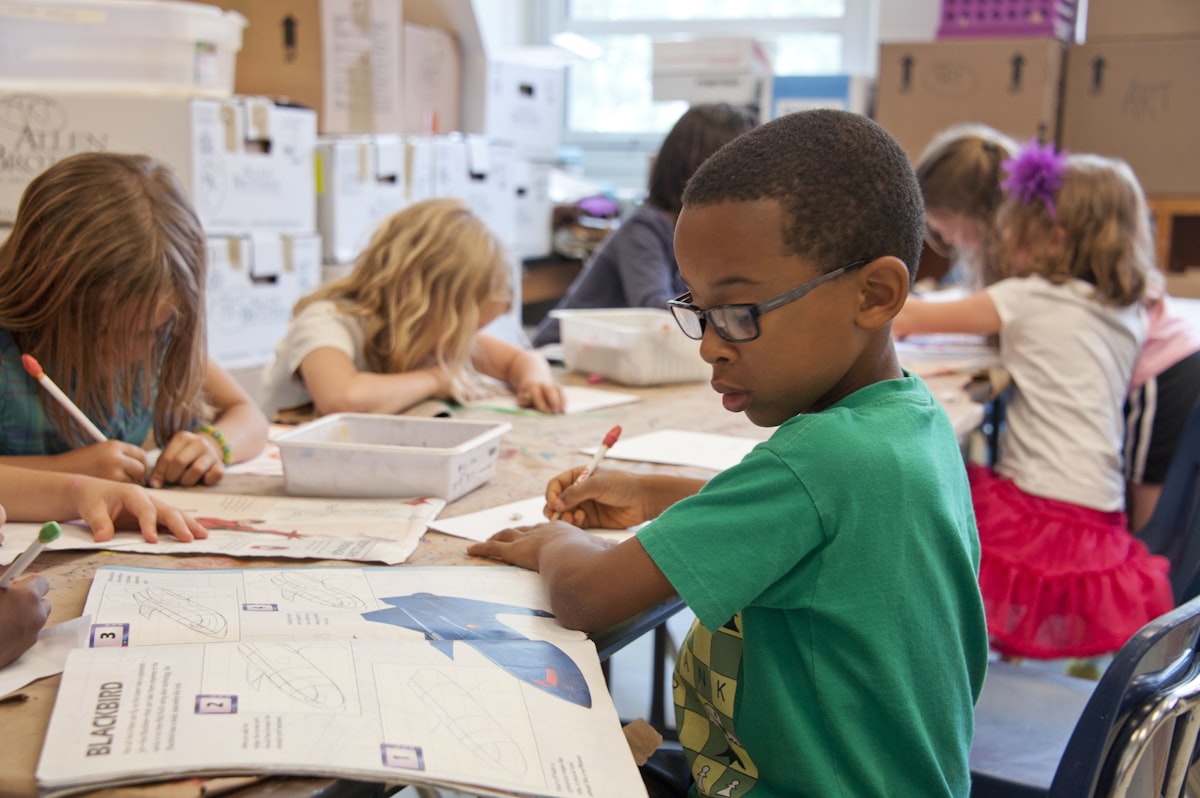
A child solving geometry problems at a desk
Tangrams are ancient Chinese puzzles with 7 geometric pieces. Children arrange them to form specific shapes. This builds spatial reasoning, rotation skills, and an intuition for how shapes combine.
4. Symmetry Art (Grades 1–4)
Fold a piece of paper in half. Paint on one side, then fold and press. Open to reveal a symmetrical design. Discuss: "What makes it symmetrical? Where is the line of symmetry?"
5. Coordinate Plane Drawing (Grades 5–8)
Give your child a list of coordinate pairs. When plotted and connected in order, they form a picture (a house, a star, an animal). This makes coordinate geometry feel like a game rather than a chore.
Common Geometry Mistakes and Fixes
Mistake
Example
Fix
Confusing perimeter and area
"The area of this rectangle is 14 cm" (actually perimeter)
Perimeter = fence around a yard; Area = grass inside the yard
Not recognizing rotated shapes
"That's not a square, it's a diamond"
Show that rotating a shape doesn't change what it is
Reading the wrong protractor scale
Reads 30° when the angle is actually 150°
"Does this angle look acute or obtuse? Does your measurement match?"
Forgetting angle relationships
Can't find a missing angle in a triangle
Drill: angles in a triangle always sum to 180°
Confusing radius and diameter
"The diameter is 5, so the circumference is 5π"
Diameter = all the way across; Radius = halfway across
When to Use Geometry Worksheets
Worksheets are most effective after hands-on exploration:
After building angles with arms → practice classifying angles on paper
After measuring real objects → practice reading protractor diagrams
For daily review → 5 minutes of geometry keeps spatial skills sharp
Before tests → mixed practice covering all concepts
Browse our complete geometry worksheet collection — 88+ worksheets covering grades 4 through 8, with angle classification, measurement, and geometric reasoning at every difficulty level.
How Geometry Connects to Other Topics
Shapes — basic shape recognition is the foundation for all geometry
Fractions — pie charts and fraction models are geometry in disguise
Measurement — length, area, and volume are geometry applications
Place value — understanding number structure helps with coordinate geometry
Algebra — coordinate geometry bridges geometry and algebra
CCSS.MATH.CONTENT.K.G.A.1 — Describe objects using names of shapes, and describe relative positions
CCSS.MATH.CONTENT.1.G.A.1 — Distinguish between defining attributes of shapes vs. non-defining attributes
CCSS.MATH.CONTENT.4.G.A.1 — Draw and identify lines and angles, and classify shapes by properties of their lines and angles
CCSS.MATH.CONTENT.4.MD.C.5 — Recognize angles as geometric shapes formed where two rays share a common endpoint, and understand concepts of angle measurement
CCSS.MATH.CONTENT.4.MD.C.6 — Measure angles in whole-number degrees using a protractor
CCSS.MATH.CONTENT.7.G.B.5 — Use facts about supplementary, complementary, vertical, and adjacent angles to solve problems
CCSS.MATH.CONTENT.8.G.B.7 — Apply the Pythagorean Theorem to determine unknown side lengths in right triangles
These standards span the full K–8 geometry progression covered in this guide, from naming shapes to applying the Pythagorean theorem.
Start Exploring Geometry Today
Geometry is everywhere — in the buildings your child walks past, the patterns on their clothes, and the angles they create when they throw a ball. The more you help them see geometry in the real world, the more natural the formal math will feel.
Here's your action plan:
Start with what they see — point out shapes, angles, and lines in everyday life
Use their hands — build shapes, fold paper, stretch geoboards before writing anything down
Build vocabulary gradually — acute, obtuse, right, parallel, perpendicular — one term at a time
Practice with worksheets — our geometry worksheets cover grades 4–8 with 88+ problems at every level
Connect to the real world — architecture, art, sports, nature — geometry is the math of the visual world
Help your child see that geometry isn't just lines on paper — it's the shape of everything around them.