Fun Multiplication Activities for Third Grade at Home
Oh My Homeschool·
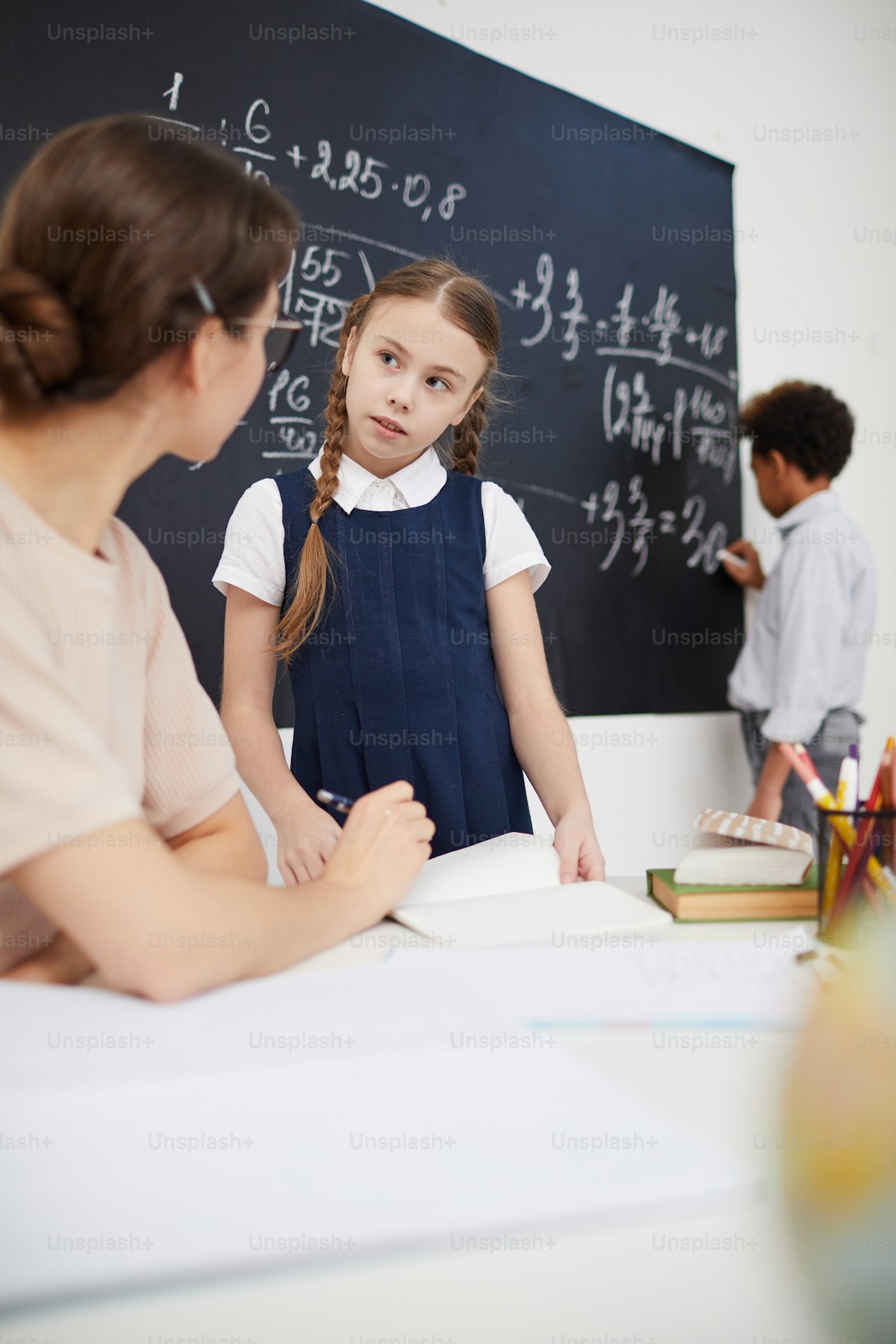
A student learning math with equations on a chalkboard in the background
Third grade is when multiplication enters the picture, and for many children, it feels like a giant leap. After spending first and second grade mastering addition and subtraction, suddenly they're expected to understand an entirely new operation — one that involves memorizing dozens of facts, grasping the concept of equal groups, and applying these skills to real-world problems. The challenge is real, but here's the good news: with the right fun multiplication activities for third grade, you can transform what often feels like tedious memorization into engaging, hands-on learning that actually sticks. This guide shares proven activities, games, and strategies that make multiplication click for third graders, whether you're homeschooling or reinforcing classroom learning at home.
Why Third Graders Struggle with Multiplication
Colorful geometric shapes and blocks arranged in a pattern
Before diving into activities, it helps to understand why multiplication can be challenging for eight- and nine-year-olds. The most common struggles fall into a few predictable categories.
The Memorization Trap
Many children (and parents) assume that learning multiplication means memorizing all the times tables from 1 through 12. While fluency with multiplication facts is important, jumping straight to memorization without building conceptual understanding is like asking a child to memorize spelling words in a language they don't speak. The facts won't stick because they have nothing to attach to. The most effective approach builds understanding first, then uses that understanding as scaffolding for memorization.
The Leap from Addition
Addition is intuitive — children can see it, count it, and verify it on their fingers. Multiplication requires a more abstract kind of thinking. Understanding that 4 x 3 means "four groups of three" or "three taken four times" requires children to hold multiple pieces of information in their minds simultaneously. This cognitive demand is genuinely new and takes time to develop.
third grademultiplicationmath activitiestimes tableshomeschool mathgrade 3
Many traditional approaches to multiplication rely heavily on worksheets and flash cards from the start. But third graders still benefit enormously from concrete, physical experiences with math. They need to touch, arrange, count, and see multiplication in action before they can work with it abstractly on paper.
Building Conceptual Understanding First
The key to making multiplication fun is making it understandable. When children grasp what multiplication actually means, practicing it becomes satisfying rather than frustrating.
Equal Groups
Start with the simplest model: equal groups. Place three cups on the table, each containing four crackers. Ask your child "How many crackers are there in all?" Count together. Then introduce the language: "Three groups of four equals twelve. We can write that as 3 x 4 = 12." Use different objects and group sizes. The goal is for your child to see that multiplication is simply a faster way to count equal groups — something they've been doing informally for years.
Arrays and Area Models
Arrays are one of the most powerful visual models for multiplication. An array is simply a rectangular arrangement of objects in rows and columns. Have your child arrange 12 coins into different arrays: 3 rows of 4, 2 rows of 6, 4 rows of 3, 6 rows of 2. This naturally demonstrates the commutative property (3 x 4 = 4 x 3) without requiring a formal lesson on the concept. Grid paper is your best friend here — children can color in rectangles and count the squares to discover multiplication facts on their own.
Skip Counting Connection
If your child can skip count, they already know the foundations of multiplication. Skip counting by 5s (5, 10, 15, 20, 25) is the same as the 5 times table. Skip counting by 2s (2, 4, 6, 8, 10) is the 2 times table. Making this connection explicit helps children realize they already know more multiplication than they think. Practice skip counting with a number line, a hundred chart, or even by jumping on numbered tiles taped to the floor.
Fun Hands-On Multiplication Activities
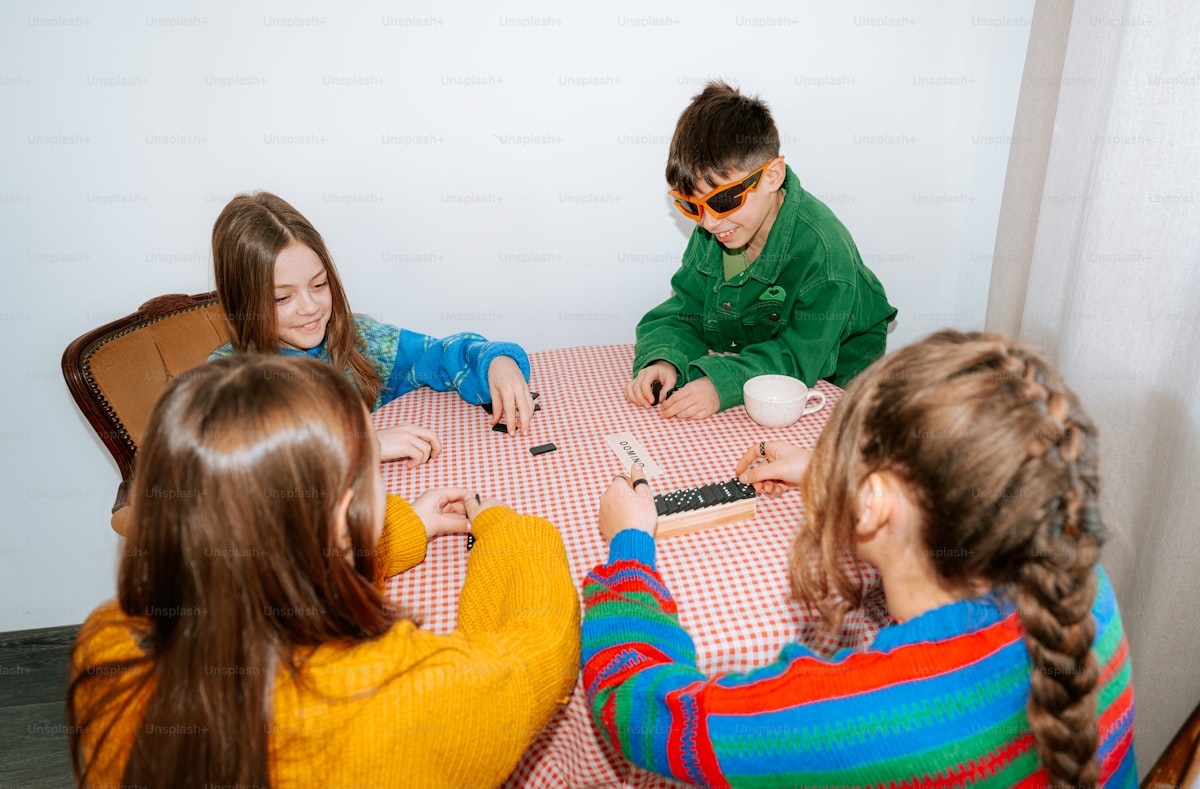
Children gathered around a table playing a game together
These activities use materials you probably already have at home. They're designed to be genuinely enjoyable — not "educational activities disguised as fun" that children see through immediately, but activities that are actually engaging because they involve play, challenge, and discovery.
Array Art
Give your child a sheet of grid paper and colored markers or stickers. Challenge them to create pictures using only rectangular arrays. A house might have a 5 x 3 array of red squares for the wall, a 2 x 3 array of blue squares for the door, and a 4 x 4 array of yellow squares for the roof. After completing the picture, they write the multiplication equation for each section. This combines creativity with math practice in a way that most children genuinely enjoy.
Multiplication War (Card Game)
This is a simple adaptation of the classic card game War. Remove the face cards from a standard deck (or assign them values: Jack = 11, Queen = 12, King = 0). Each player flips two cards and multiplies them. The player with the higher product wins all four cards. If products are equal, it's "war" — each player flips two more cards. This game is engaging because it has the competitive element of a real card game, and children end up practicing dozens of multiplication facts without it feeling like drill work. Play for ten minutes after dinner and your child will have practiced more facts than a full worksheet would cover.
Roll and Multiply (Dice Game)
You need two dice (or three for a challenge). Roll both dice and multiply the numbers. The first player to reach a target score (100 works well) wins. For variety, use different colored dice and assign one as the "groups" die and one as the "size of each group" die. This adds the conceptual element — "I rolled a 4 and a 6, so that's four groups of six, which is twenty-four." For more advanced practice, use 10-sided dice or 12-sided dice to practice larger facts.
Egg Carton Arrays
Take an empty egg carton (12-cup) and small objects like buttons, dried beans, or pom-poms. Call out a multiplication fact — say, "3 times 4" — and have your child place objects to show 3 rows of 4 in the egg carton. Then count to verify. This is especially effective for children who are still building conceptual understanding, because the egg carton provides a built-in grid structure.
Multiplication Scavenger Hunt
Create cards with multiplication expressions (3 x 5, 2 x 7, 4 x 4) and hide them around the house or yard. Your child finds each card, solves it, and records the answer on a master sheet. For added challenge, the answers form a secret code that reveals a prize or next clue. This turns practice into an adventure and gets children moving — a huge benefit for kids who struggle to sit still during traditional practice.
Cooking with Multiplication
Baking is naturally full of multiplication. If a recipe serves 4 and you need to serve 12, you're multiplying by 3. If each cookie needs 3 chocolate chips for a face and you're making 8 cookies, how many chocolate chips do you need? Involve your child in doubling or tripling recipes, counting ingredients into equal groups, and figuring out how many servings different quantities will make. The real-world application helps children see why multiplication matters beyond the math worksheet.
Using Worksheets to Build Fluency
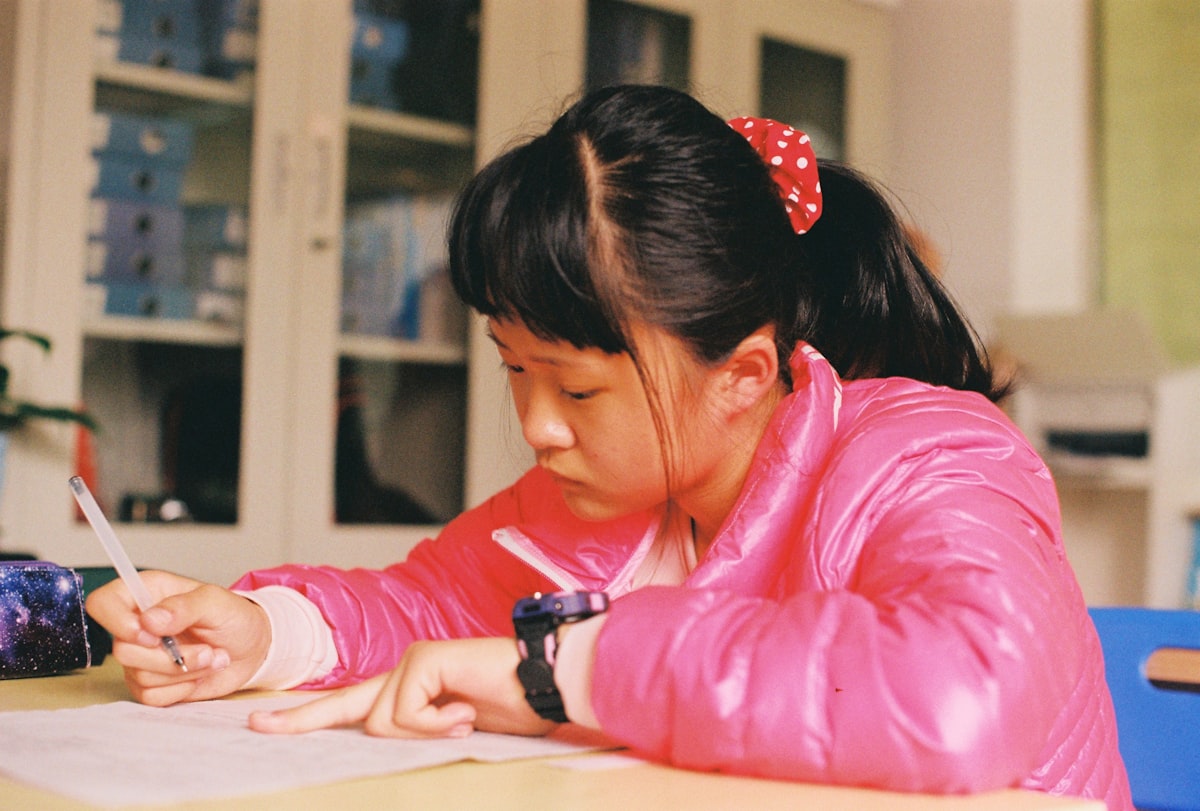
A girl focused on completing math problems at her desk
Once your child understands what multiplication means through hands-on activities and games, worksheets become a powerful tool for building speed and fluency. The key is timing — worksheets should reinforce understanding that already exists, not replace the process of building it.
When to Introduce Worksheets
Your child is ready for multiplication worksheets when they can explain what a multiplication expression means using words or pictures (for example, "3 x 5 means three groups of five"), when they can solve basic facts using a strategy (skip counting, drawing arrays, using known facts) even if they're not yet fast, and when they show interest in doing "real math work" on paper.
What to Look for in Good Multiplication Worksheets
The best third-grade multiplication worksheets start with visual support — pictures of arrays or groups alongside the equations. They progress from single-digit facts (2s, 5s, 10s first) to harder facts (6s, 7s, 8s). They include a mix of problem types — straight computation, word problems, fill-in-the-blank, and matching. They don't overload with too many problems per page. Twelve to fifteen problems is plenty for a single session. Browse our third grade multiplication worksheets to find practice materials that progress with your child's skill level.
How to Use Worksheets Effectively
Limit worksheet sessions to ten to fifteen minutes. Pair each worksheet session with a quick game or hands-on activity. Review mistakes together — errors are learning opportunities, not failures. Track progress over time so your child can see improvement. If your child gets frustrated, go back to hands-on activities for a few days before trying worksheets again.
Creating a Weekly Multiplication Practice Routine
Consistency matters more than intensity when it comes to learning multiplication facts. A short daily practice session is far more effective than one long weekly session.
Sample Weekly Schedule
Monday: New fact introduction with manipulatives (10 minutes). Introduce a new times table using equal groups and arrays.
Tuesday: Game day (15 minutes). Play Multiplication War, Roll and Multiply, or another game focusing on the new facts plus review facts.
Wednesday: Worksheet practice (10 minutes). Complete a worksheet that mixes the new facts with previously learned facts.
Thursday: Real-world multiplication (10 minutes). Find multiplication in cooking, shopping, organizing, or building projects.
Friday: Assessment and celebration (10 minutes). A quick quiz or timed challenge (only if your child enjoys the challenge — skip this if timed work causes anxiety). Celebrate progress and set goals for next week.
Which Times Tables to Teach First
Not all times tables are equally difficult. Here's the most effective teaching order.
Start with 2s, 5s, and 10s — these connect directly to skip counting skills your child already has. Most children master these quickly, which builds confidence.
Next, tackle 3s and 4s — these can be derived from doubling. 3 x 6 is the same as (2 x 6) + 6. 4 x 7 is the same as double (2 x 7).
Then move to 9s — the 9s have many patterns and tricks (the digits always add up to 9, the tens digit is one less than the multiplier) that make them satisfying to learn.
6s, 7s, and 8s come last — by this point, your child already knows many of these facts from learning the earlier tables (6 x 3 was already learned as 3 x 6). The truly new facts at this stage are just 6 x 6, 6 x 7, 6 x 8, 7 x 7, 7 x 8, and 8 x 8.
Finally, 11s and 12s — 11s have an obvious pattern, and 12s can be broken into (10 x n) + (2 x n).
Connecting to What Came Before and What Comes Next
Multiplication doesn't exist in isolation. It builds directly on the addition and subtraction skills your child developed in first grade. When your child uses repeated addition to check a multiplication answer, or when they decompose a hard fact into easier ones (7 x 8 = 7 x 4 + 7 x 4), they're using addition strategies in a new context.
Looking ahead, the multiplication fluency your child builds now will be essential for fourth-grade division, fractions, and multi-digit multiplication. Every fact they master this year is one less obstacle they'll face next year. If you're looking for additional math resources for younger learners, our guide on best math worksheets for kindergarten covers the foundational number sense skills that make operations like multiplication possible.
CCSS.MATH.CONTENT.3.OA.A.1 — Interpret products of whole numbers, e.g., interpret 5 x 7 as the total number of objects in 5 groups of 7 objects each.
CCSS.MATH.CONTENT.3.OA.A.3 — Use multiplication and division within 100 to solve word problems in situations involving equal groups, arrays, and measurement quantities.
CCSS.MATH.CONTENT.3.OA.A.4 — Determine the unknown whole number in a multiplication or division equation relating three whole numbers.
CCSS.MATH.CONTENT.3.OA.B.5 — Apply properties of operations as strategies to multiply and divide (commutative, associative, and distributive properties).
CCSS.MATH.CONTENT.3.OA.C.7 — Fluently multiply and divide within 100, using strategies such as the relationship between multiplication and division. By the end of Grade 3, know from memory all products of two one-digit numbers.
The hands-on activities (equal groups, arrays, skip counting) build toward standard 3.OA.A.1, while the games and worksheets develop the fluency required by 3.OA.C.7. When your child uses known facts to derive unknown facts (like doubling 2 x 6 to find 4 x 6), they're practicing the strategies described in 3.OA.B.5.
Making Multiplication a Positive Experience
A confident young student holding a notebook and smiling
The single most important thing you can do for your third grader's multiplication journey is to keep it positive. Math anxiety is real, and it often starts during the multiplication years when children feel pressured to memorize facts quickly. Here are a few principles to keep in mind.
Celebrate strategies, not just speed. A child who can figure out 7 x 8 by thinking "7 x 7 is 49, plus one more 7 is 56" is demonstrating sophisticated mathematical reasoning, even if they're not fast yet. Speed will come with practice.
Avoid timed tests if they cause stress. Some children thrive on the challenge of timed quizzes. Others freeze up and develop anxiety that actually slows their progress. Know your child and adjust accordingly.
Make it social. Play multiplication games with siblings, friends, or parents. Learning is more fun when it's shared, and explaining your thinking to someone else deepens understanding.
Be patient with the 6s, 7s, and 8s. These are genuinely the hardest multiplication facts. Almost every child struggles with them. If your third grader knows their 2s through 5s fluently and is working on the rest, they're exactly where they should be.
Multiplication is a marathon, not a sprint. With engaging activities, consistent practice, and a supportive environment, your third grader will build the fluency and confidence that sets them up for success in every math challenge ahead. Trust the process, keep it fun, and remember — every great mathematician started by counting groups of crackers on the kitchen table.