First Grade Addition and Subtraction: Proven Strategies to Build Math Confidence
Oh My Homeschool·
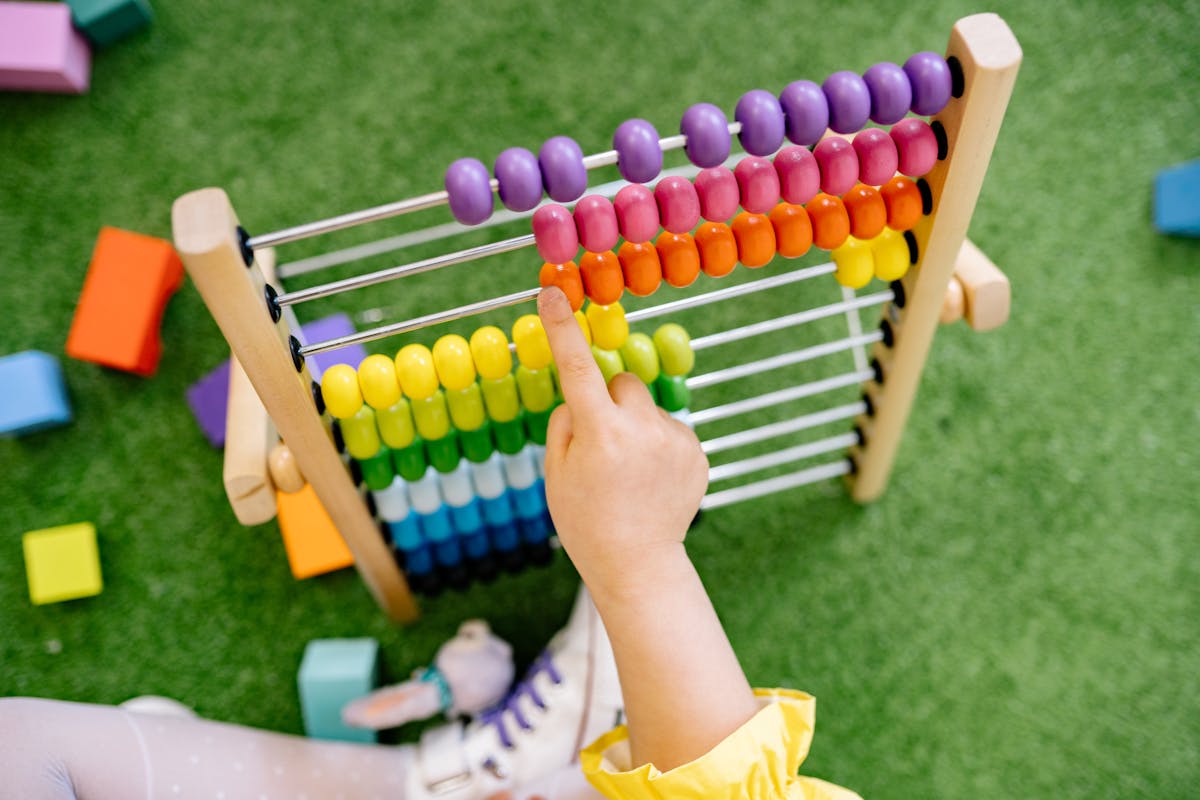
A child learning to count with colorful counting tools
First grade marks a pivotal transition in your child's math journey. While kindergarten focused on counting, number recognition, and the very basics of putting numbers together, first grade is where children develop real fluency with addition and subtraction — skills that become the foundation for everything from multiplication to algebra. The good news is that with the right strategies, consistent practice, and a supportive environment, every child can build strong math confidence during this critical year. This guide walks you through proven approaches that work whether you're homeschooling full-time or supplementing classroom learning at home.
What First Graders Need to Know
Before diving into specific strategies, it helps to understand the math expectations for first grade. Most educational standards require first graders to master several key skills by year's end.
Addition and subtraction within 20 is the core goal. Children should be able to fluently add and subtract within 10, and demonstrate understanding of addition and subtraction within 20 using strategies like counting on, making ten, and decomposing numbers. They should also understand the relationship between addition and subtraction — that if 3 + 4 = 7, then 7 - 4 = 3.
Beyond computation, first graders need to solve word problems involving addition and subtraction within 20. They should work with equations that have the unknown in all positions: 5 + ? = 9, not just 5 + 4 = ?. This kind of flexible thinking about numbers sets the stage for algebraic reasoning later.
Key milestones to track:
Add and subtract within 10 fluently (by memory or quick mental math)
Add and subtract within 20 using strategies
Understand the meaning of the equal sign (it means "the same as," not "the answer comes next")
Solve addition and subtraction word problems
Determine if equations are true or false (e.g., 6 = 6, 7 = 8 - 1)
Teaching Addition: Start with Concrete, Move to Abstract
grade 1first gradeadditionsubtractionmath worksheetshomeschool mathnumber sense
A tutor helping a child with math homework during a learning session
The most effective approach to teaching addition follows a well-researched progression: concrete → pictorial → abstract. Children who jump straight to memorizing facts without building conceptual understanding often struggle when problems become more complex.
Counting On
Counting on is typically the first addition strategy children master. Instead of counting all objects from one, children start from the larger number and count up. For 3 + 5, a child learns to start at 5 and count "6, 7, 8" rather than counting all eight objects individually.
How to practice counting on:
Use a number line posted on the wall or desk — point to the larger number and hop forward
Practice with dice games: roll two dice, start from the bigger number, count on the smaller
Use fingers strategically: hold the smaller number on fingers and count on from the larger
Making Ten
Making ten is one of the most powerful strategies in early math. Children learn that 10 is a "friendly number" and use it as a bridge for harder problems. For example, 8 + 5 becomes 8 + 2 + 3, or (8 + 2) + 3 = 10 + 3 = 13.
How to teach making ten:
Start with ten frames — physical or printed grids of two rows of five
Practice "what makes ten" pairs until they're automatic: 1+9, 2+8, 3+7, 4+6, 5+5
Use the phrase "How many more to make ten?" repeatedly in daily conversation
Play card games where the goal is making pairs that sum to 10
Doubles and Near Doubles
Doubles facts (2+2, 3+3, 4+4, etc.) are naturally easy for children to memorize because of their pattern and rhythm. Once doubles are solid, children can use "near doubles" or "doubles plus one" for related facts: if 6 + 6 = 12, then 6 + 7 = 13.
Fun ways to practice doubles:
Sing doubles songs or chants
Use mirrors: place 4 objects in front of a mirror — how many do you see total?
Connect to real life: "You have 5 fingers on each hand — that's 5 + 5!"
Draw "doubles pictures": a ladybug with equal spots on each wing
Teaching Subtraction: Building on Addition Knowledge
Subtraction is often harder for children because it requires thinking in a direction that feels less natural. The key insight for parents is that subtraction isn't a completely separate skill — it's the inverse of addition, and teaching this connection explicitly accelerates learning.
Think Addition for Subtraction
Instead of teaching subtraction as "taking away," help children see it as "what do I need to add?" For 13 - 5, instead of counting backward from 13, children can think "5 + ? = 13" and count up from 5 to 13. This strategy, called "think addition" or "counting up," is more accurate and builds number sense.
Practice activities:
Use part-part-whole mats: write 13 in the "whole" section, 5 in one "part," and find the missing part
Play "what's missing" with objects: show 8 items, hide some, ask how many are hidden
Number lines provide a visual anchor for subtraction. Children can start at the larger number and hop backward, or start at the smaller number and count the distance (jumps) to the larger number. The second approach — counting up on a number line — is particularly powerful because it connects subtraction to addition.
Tips for number line subtraction:
Use a large floor number line that children can physically walk along
Start with subtraction within 10 before moving to within 20
Encourage children to decide whether to count back or count up depending on the numbers
For problems like 12 - 9, counting up (9 → 12 = 3 jumps) is much easier than counting back 9
Hands-On Activities That Make Practice Fun
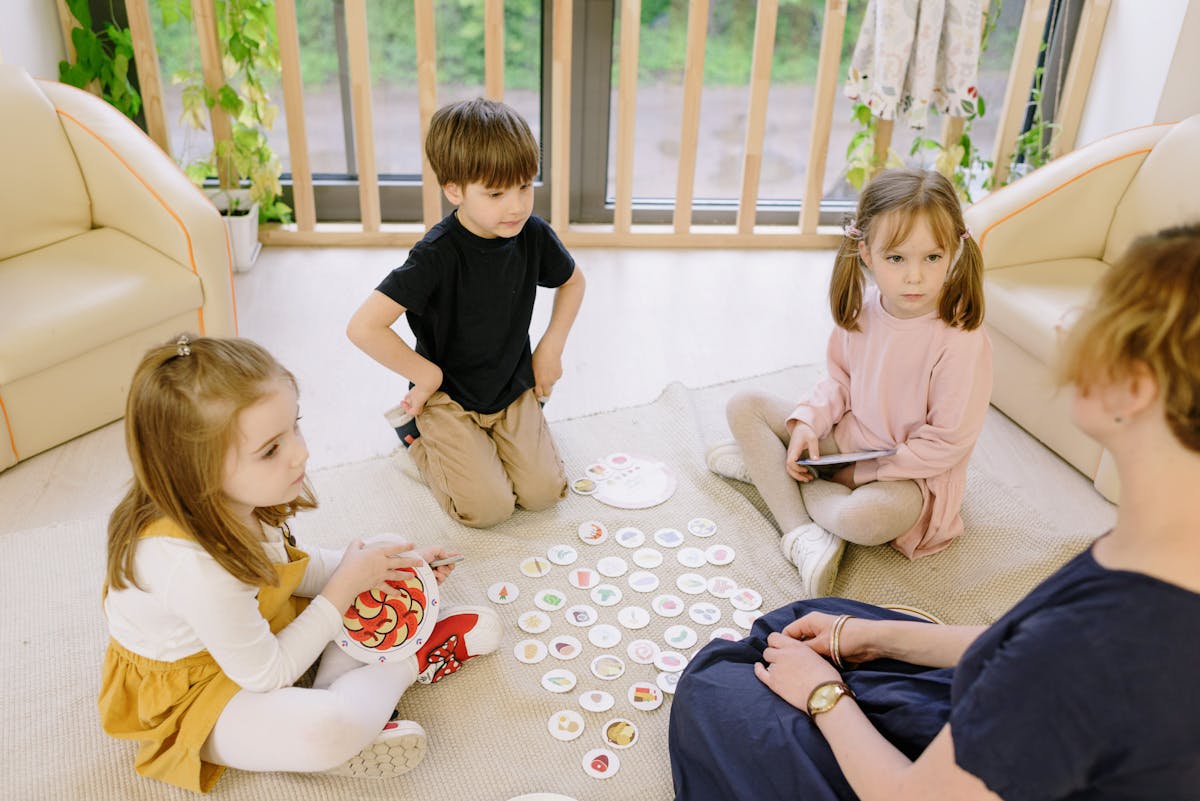
Children engaged in a learning activity together
Worksheets are valuable for building fluency, but they work best when combined with hands-on activities that make math feel like play rather than work. First graders learn best through movement, games, and real-world connections.
Everyday Math Moments
The most effective math practice happens naturally throughout the day. Look for opportunities to incorporate addition and subtraction into daily routines:
Grocery shopping: "We have 3 apples in the cart. We need 8 total. How many more should we grab?"
Setting the table: "There are 6 people coming for dinner. We've set 4 places. How many more do we need?"
Snack time: "You have 10 crackers. If you eat 3, how many will be left?"
Building with blocks: "You used 7 red blocks and 5 blue blocks. How many blocks did you use altogether?"
Math Games
Games remove the pressure of "getting it right" and let children practice in a low-stakes, enjoyable context.
War with a twist: Each player flips two cards and adds them — higher sum wins the round
Subtraction bowling: Set up 10 "pins" (bottles, blocks), roll a ball, subtract the knocked-down pins from 10
Dice addition races: Roll two dice, add the numbers, move that many spaces on a board
Domino addition: Flip a domino — add the two sides together
Strategic Worksheet Practice
Worksheets become powerful tools when used strategically. Rather than assigning 30 random problems, focus on targeted practice.
Best practices for worksheet use:
Start with problems your child can solve successfully (build confidence first)
Focus on one strategy at a time — a sheet of "making ten" problems, not a mix of everything
Keep sessions short: 10-15 minutes of focused practice beats 30 minutes of frustrated work
Review errors together — mistakes reveal which strategies need more practice
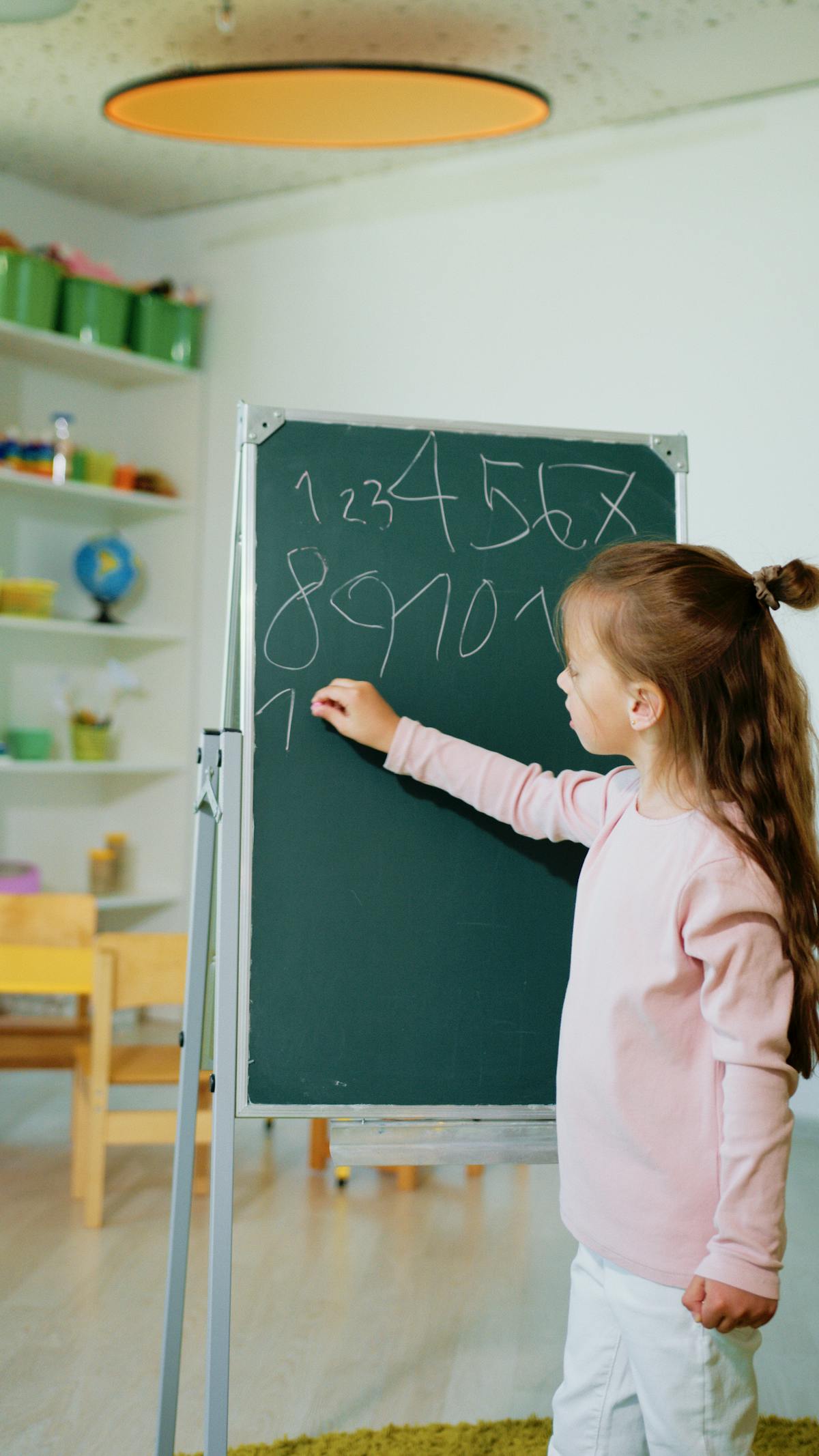
A child practicing writing numbers and solving problems
Understanding common errors helps you intervene early and build stronger understanding.
Counting Errors
The most common first-grade math mistake is counting on from the wrong number. When adding 4 + 3, a child might count "4, 5, 6" (getting 6) instead of "5, 6, 7" (getting 7). The fix is to emphasize that counting on starts with the next number, not the starting number itself. Use physical objects to demonstrate: "We already have 4, so the next one makes 5."
Confusing Addition and Subtraction
Some children struggle to determine which operation a word problem requires. Key language clues help:
Addition signals: "in all," "altogether," "total," "both," "combined," "how many more are added"
Subtraction signals: "how many are left," "difference," "fewer," "how many more," "take away"
Practice identifying the operation before solving — "Is this a putting together problem or a taking apart problem?"
Over-Reliance on Finger Counting
Finger counting is a perfectly valid strategy in early first grade, but children should gradually transition to mental strategies. If your child is still counting every problem on fingers by mid-year, explicitly teach the strategies above (counting on, making ten, doubles) as faster alternatives. Don't ban fingers — instead, make mental strategies feel easier and more efficient.
Rushing Through Problems
Speed is not the goal in first grade — understanding is. Children who rush often make careless errors and don't develop the number sense needed for harder math later. Encourage your child to check their work: "Does your answer make sense? Is 3 + 4 really 6? Let's check."
Building Fact Fluency Without Tears
A child writing in a notebook with a pencil
Fact fluency — the ability to recall basic addition and subtraction facts quickly and accurately — is an important goal, but it should be built on understanding, not rote memorization. Research consistently shows that children who understand why facts work remember them longer and can apply them more flexibly.
The Fluency Progression
Follow this sequence for building lasting fluency:
Conceptual understanding — Understand what addition and subtraction mean using objects and stories
Strategy development — Learn and practice strategies like counting on, making ten, and doubles
Reasoning practice — Use known facts to figure out unknown facts ("I know 6 + 6 = 12, so 6 + 7 must be 13")
Fluency — Through repeated strategic practice, facts become automatic
Recommended Daily Practice Routine
A consistent 15-minute daily math routine produces remarkable results over time:
2 minutes: Warm-up with oral fact practice ("What's 5 + 3? What's 10 - 7?")
5 minutes: Strategy-focused practice (worksheet or activity targeting one strategy)
5 minutes: Problem solving (one or two word problems)
3 minutes: Math game or fun challenge
This structure keeps sessions short enough to maintain focus while covering all the essential skills. Consistency matters more than duration — 15 minutes every day beats an hour once a week.
When to Move On
How do you know when your child is ready for more challenging work? Look for these signs:
They can answer addition and subtraction facts within 10 in under 3 seconds each
They can explain their thinking — "I know 8 + 6 is 14 because 8 + 2 is 10, and 4 more is 14"
They can solve simple word problems without help
They show confidence rather than frustration when facing new problems
When these signs appear, gradually introduce facts within 20, multi-step problems, and eventually the connection to place value and two-digit numbers.
Recommended Resources for Practice
Consistent practice with well-designed materials makes all the difference. Here are the types of resources that work best for first-grade math:
Printable worksheets provide structured, focused practice. Look for worksheets that isolate specific skills (addition within 10, subtraction from 20, making ten problems) rather than mixing everything together. Our Grade 1 math worksheets offer exactly this kind of targeted practice, with problems carefully sequenced from easier to more challenging.
Manipulatives — physical objects children can touch and move — remain important in first grade. You don't need expensive math kits. Simple household items work perfectly: buttons, beans, pennies, small blocks, or even cereal pieces. Ten frames (a 2x5 grid) are particularly useful and easy to make from an egg carton with two cups cut off.
Number lines should be visible and accessible in your learning space. A simple number line from 0 to 20 taped to the desk or wall gives children a constant reference point for both addition and subtraction.
Math read-alouds make concepts stick through storytelling. Books like "The Action of Subtraction" by Brian Cleary and "Mission: Addition" by Loreen Leedy combine engaging stories with math concepts in ways that feel natural rather than forced.
CCSS.MATH.CONTENT.1.OA.A.1 — Use addition and subtraction within 20 to solve word problems involving situations of adding to, taking from, putting together, taking apart, and comparing, with unknowns in all positions.
CCSS.MATH.CONTENT.1.OA.A.2 — Solve word problems that call for addition of three whole numbers whose sum is less than or equal to 20.
CCSS.MATH.CONTENT.1.OA.B.3 — Apply properties of operations as strategies to add and subtract (commutative and associative properties of addition).
CCSS.MATH.CONTENT.1.OA.C.5 — Relate counting to addition and subtraction (e.g., by counting on 2 to add 2).
CCSS.MATH.CONTENT.1.OA.C.6 — Add and subtract within 20, demonstrating fluency for addition and subtraction within 10. Use strategies such as counting on, making ten, decomposing a number leading to a ten, and creating equivalent but easier or known sums.
When you follow the strategies in this guide — counting on, making ten, doubles, and think-addition for subtraction — you're directly supporting your child's progress toward these standards.
First-grade math is ultimately about building confidence alongside competence. When children believe they can do math — when they see themselves as "math people" — they approach new challenges with curiosity rather than anxiety. Your role as a parent or educator is to provide the right level of challenge, celebrate strategic thinking over speed, and create an environment where mistakes are learning opportunities rather than failures. With consistent practice, thoughtful strategies, and plenty of encouragement, your first grader will build the strong mathematical foundation that supports all future learning.