How to Teach Fractions to Kids: A Parent's Complete Guide
Oh My Homeschool·
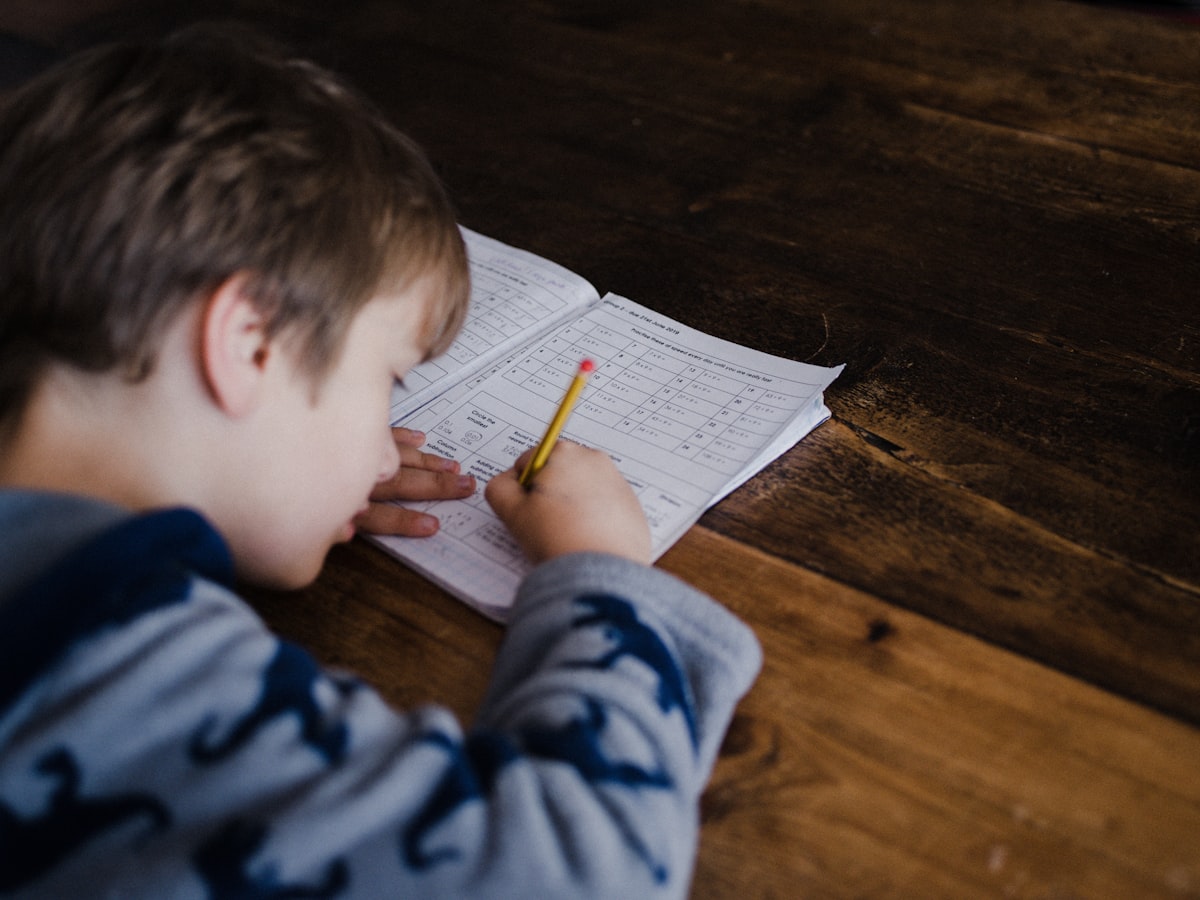
A child learning about fractions with colorful visual models at home
Fractions are the topic that splits elementary math into two eras: before fractions and after. Before, everything is whole numbers — countable, concrete, intuitive. After, math becomes a world of parts, ratios, and relationships. How well children cross that bridge determines not just their fraction skills, but their long-term success in algebra, geometry, and beyond.
The good news is that fractions are not inherently difficult. The problem is almost always how they are taught. Children who learn fractions as rules and procedures — "flip and multiply," "find the common denominator" — often memorize without understanding. Those who learn through visual models and careful conceptual progression develop fluency that lasts. This guide gives you the second approach.
Why Fractions Are Hard — And What to Do About It
Before jumping into strategies, it helps to understand why fractions cause so much difficulty.
The core problem is that fractions violate almost everything children have learned about numbers up to that point. In whole number arithmetic:
Bigger numbers are always larger (5 > 3)
Multiplying makes things bigger
The number 3 always means "three of something"
In fraction arithmetic, all three of these "rules" break. One-third is larger than one-fifth — but 3 < 5. Multiplying two fractions can give a result smaller than either original fraction. And in 3/4, the number 3 doesn't mean "three" in any simple sense.
Children aren't confused about fractions because they aren't smart enough. They're confused because their brains are applying rules that worked for years but no longer apply. Your job as a teacher is to make the new rules visible — and the best way to do that is through representations that can be seen, touched, and moved.
The Three-Phase Teaching Approach
Research consistently supports a three-phase approach to teaching any new math concept, and fractions are no exception:
fractionsgrade 2grade 3grade 4grade 5elementary mathhomeschool math
Representational — pictures and diagrams (number lines, area models, drawings)
Abstract — symbols and equations (1/2 + 1/4 = 3/4)
The most common teaching mistake is skipping straight to phase 3. Children who jump to symbols before they have concrete and visual experience become "fraction rule followers" — able to compute correctly under familiar conditions but unable to recover when something unexpected happens.
What Children Should Know Before Fractions
Strong fraction learning depends on three prerequisites. If your child is weak in any of these areas, spend time there before introducing fraction notation.
Equal sharing: Children should understand that "equal" means "the same amount," not just "the same number of pieces." Cutting a pizza into one large piece and one small piece gives two pieces, but not two equal shares. This concept — equal partitioning — is the foundation of fractions.
Multiplication and division fluency: Fraction operations involve multiplication and division. Children who are still shaky on their multiplication facts will struggle with fraction computation. A week of fact review before fraction operations is always worth it.
Number sense: Fractions live between whole numbers on the number line. Children need a strong sense of whole number magnitude before they can reason about fractions. "Is 3/4 closer to 0 or closer to 1?" requires number sense that worksheets alone don't build.
The Learning Progression: Grades 2–5
Fraction understanding develops across four grade levels in a carefully designed sequence. Each year's learning depends on the year before.
Grade
Key Concepts
2
Equal shares, partitioning shapes into halves/thirds/fourths
3
Fraction notation, unit fractions, equivalent fractions, comparing, number line
4
Adding/subtracting like fractions, mixed numbers, multiplying fractions by whole numbers
5
Adding/subtracting unlike fractions, multiplying fractions, interpreting fractions as division
Skipping or rushing any stage creates gaps that compound. A student who doesn't fully understand equivalent fractions in 3rd grade will struggle with adding unlike denominators in 5th grade — and with proportional reasoning in 6th grade.
Teaching Fractions in Grade 2: Equal Parts
In second grade, children don't use fraction notation yet. The goal is to build the foundational concept: a fraction is an equal part of a whole.
Start with Shapes, Not Symbols
Show your child a circle and ask: "If we share this pizza between two people so each person gets the same amount, how do we cut it?" Have them draw the cut line. Then do the same for three people, then four.
The key question at every step: "Are the parts equal? How do you know?"
This is not as obvious as it sounds. Children frequently draw unequal parts and call them "halves" or "thirds." When you ask "How do you know these are equal?", you're building the precise thinking that fractions require.
The Language Before the Labels
Before introducing the words half and quarter, let children describe what they see: "one piece out of two equal pieces." Then introduce the standard vocabulary as a shortcut: "Mathematicians call that a half."
This sequence — experience first, vocabulary second — prevents the common problem where children can say the words without understanding what they mean.
Grade 2 Practice
Our fractions worksheets for Grade 2 focus on partitioning circles and rectangles into halves, thirds, and fourths — exactly what Grade 2 standards require.
Teaching Fractions in Grade 3: The Critical Year
Third grade is the most important fraction year. This is when children learn fraction notation (1/2, 3/4), the number line, and equivalent fractions. If you have limited time to focus on one year, focus here.
Introducing the Fraction Symbol
When you write 3/4 for the first time, don't say "three over four" or "three divided by four." Say: "This means we cut something into four equal parts and took three of them."
Break down each part of the symbol explicitly:
The bottom number (denominator) tells you how many equal parts the whole was cut into
The top number (numerator) tells you how many of those parts you have
Use fraction strips — paper strips folded or cut into equal sections — to make this physical. When children can pick up a "one-third" piece and a "one-fourth" piece and hold them side by side, the notation starts to carry real meaning.
The Number Line: The Most Important Tool
The number line is the most powerful and underused tool for teaching fractions. It does two things that no other representation can do:
Shows that fractions are numbers — they live in a specific location, not just "parts of a shape"
Makes equivalent fractions visible — 1/2 and 2/4 land on exactly the same point
A student practicing fractions at a desk with visual aids
Activity: Build the Fraction Number Line
Draw a number line from 0 to 1. Have your child find and mark 1/2. Then ask: "If we cut the space between 0 and 1 into four equal pieces, where would 1/4 be? Where would 3/4 be?"
Once the fourths are marked, ask: "Is 1/2 already on our number line? What do you notice about where 1/2 and 2/4 land?" This moment — when a child sees with their own eyes that two differently-written fractions point to the same spot — is when equivalent fractions become genuinely understood rather than memorized.
Comparing Fractions: Build the Intuition First
Before any algorithm for comparing fractions, build these two intuitions:
Same denominator: "If we cut two pizzas into the same number of pieces, the one with more pieces taken is bigger." (3/5 > 2/5 because both pizzas were cut into 5 pieces, but one has 3 pieces, one has 2.)
Same numerator: "If we take the same number of pieces from two differently-cut pizzas, the pieces from the less-divided pizza are bigger." (1/3 > 1/4 because thirds are larger pieces than fourths.)
These intuitions handle most fraction comparison at the Grade 3 level. Formal cross-multiplication comes later, once intuition is solid.
Grade 3 Practice
Our fractions worksheets for Grade 3 cover identifying, writing, comparing, and finding equivalent fractions — the full Grade 3 standard scope.
Teaching Fractions in Grade 4: Operations Begin
In Grade 4, fractions become computational. Children add and subtract fractions with the same denominator, work with mixed numbers, and multiply fractions by whole numbers.
Adding and Subtracting Like Fractions
This should feel natural if the conceptual groundwork is solid. "If you have 2/7 of a pizza and add 3/7 more, you have 5/7." You're just counting pieces — the denominator (number of pieces per pizza) doesn't change.
The danger here is procedural teaching: "Add the tops, keep the bottom." Students who only hear this often generalize incorrectly to unlike denominators, getting things like 1/2 + 1/3 = 2/5. The fix is always to return to the meaning: "The bottom number tells you the size of each piece. If the pieces are the same size, you can count them together. If they're different sizes, you can't just count — you first have to cut them to the same size."
Mixed Numbers: Two Representations
Children should learn to fluently move between improper fractions and mixed numbers. The best approach uses the number line:
"Where is 5/3 on the number line?" Have your child count thirds past 1. They land between 1 and 2. "So 5/3 is the same as 1 whole and 2 extra thirds — which we write as 1 2/3."
Avoid presenting the algorithm first. Children who learn "divide the top by the bottom, the remainder becomes the new numerator" often apply it mechanically without understanding. The number line path connects the notation to real meaning.
Grade 4 Practice
A student working on math fractions practice at home
Our fractions worksheets for Grade 4 cover adding and subtracting like fractions, mixed number operations, and multiplying fractions by whole numbers with visual models.
Teaching Fractions in Grade 5: The Hardest Year
Fifth grade is where fraction learning peaks in difficulty. Children tackle:
Adding and subtracting fractions with unlike denominators
Multiplying one fraction by another
Dividing fractions
Interpreting fractions as division expressions (3/4 means 3 ÷ 4)
Unlike Denominators: The Conceptual Key
The standard algorithm for unlike fractions (find a common denominator, convert, then operate) is correct but opaque. Build the "why" first.
Use fraction strips. Show a "1/2" strip and a "1/3" strip side by side. Ask: "If I want to add these, what's the problem?" Guide the child to see: "They're cut into different sized pieces. We can't count them together until they're the same size."
Now ask: "What if we cut each piece smaller so both strips end up with the same size pieces?" They discover that cutting halves into thirds gives sixths, and cutting thirds into halves gives sixths. So 1/2 = 3/6 and 1/3 = 2/6, making the addition 3/6 + 2/6 = 5/6.
This physical process is what "finding a common denominator" actually means. Every abstract algorithm step maps to something they can see.
Multiplying Fractions: Area Model
"1/2 × 3/4" means "half of three-quarters." Use an area model:
Draw a rectangle. Shade 3/4 of it horizontally. Then shade 1/2 of the rectangle vertically. The overlap — the region that is shaded in both directions — represents 1/2 × 3/4. Count the overlap pieces (3) out of total pieces (8): 3/8.
This model makes the "multiply tops, multiply bottoms" rule completely visible. The product of the numerators gives you the overlap count. The product of the denominators gives you the total count. No mystery.
Fractions as Division
One of the most important (and most skipped) Grade 5 concepts: 3/4 means 3 ÷ 4.
Activity: "If 3 people share 4 pizzas equally, how much does each person get?" The answer is 4/3, or 1 1/3. Now try it the other way: "If 4 people share 3 pizzas equally, how much does each person get?" The answer is 3/4.
This connection helps enormously when students reach algebraic fractions and needs to understand that rational expressions are just division.
Grade 5 Practice
Our fractions worksheets for Grade 5 cover unlike denominators, fraction multiplication, and word problems — the complete Grade 5 fraction scope.
5 Core Teaching Strategies That Work
Across all grade levels, these five strategies separate effective fraction teaching from frustrating fraction teaching.
1. Always Use Multiple Representations
Never let your child practice fractions in only one form. Every concept should appear as:
A physical model (strips, food, blocks)
A picture or diagram
A number line
A symbol (1/2)
A verbal description ("one half")
Students who know fractions in all five representations are flexible thinkers. Students who only know the symbolic form are rule-followers who get confused when the problem looks different.
2. Ask "Why" Before "How"
Before teaching any procedure — how to find common denominators, how to convert mixed numbers — ask why the procedure is needed. "What's the problem we're trying to solve?" "Why can't we just add the tops and the bottoms?"
Children who understand the why can reconstruct procedures they've forgotten. Children who only know the how are stuck when their memory fails.
3. Use Estimation Before Calculation
Before computing 3/5 + 7/8, ask: "Is this going to be more or less than 1? How do you know?" (3/5 is more than half, 7/8 is almost 1, so together they're definitely more than 1.)
Estimation builds number sense, catches computational errors, and develops the proportional reasoning that fraction understanding ultimately feeds.
4. Connect Fractions to Real Contexts Throughout
A child doing homeschool math with colorful fraction materials
The best fraction problems are real:
Recipe scaling ("This recipe makes 12 cookies. How much of each ingredient for 9 cookies?")
Fair sharing ("Four people share 3 granola bars. How much does each person get?")
Time ("School ends in 45 minutes. What fraction of an hour is that?")
Measurement ("The window is 3/4 of a meter wide. How wide is that in centimeters?")
Real contexts give fractions meaning and make errors obvious. "A person can't eat 2/7ths of a negative pizza" is a built-in sanity check that abstract computation doesn't provide.
5. Treat Mistakes as Data, Not Failures
The most valuable thing a child's fraction errors tell you is exactly what they don't yet understand. The classic "add numerator and denominator" error (1/3 + 1/4 = 2/7) shows the child doesn't yet understand what the denominator means. The fix isn't to correct and repeat — it's to go back to fraction strips and rebuild the understanding from the ground up.
When you treat errors as diagnostic information rather than failures, children feel safe to try rather than guessing what you want to hear.
Common Fraction Mistakes and How to Fix Them
Mistake
What It Reveals
Fix
1/3 + 1/4 = 2/7 (adding tops and bottoms)
Doesn't understand what denominator means
Return to physical strips; show that you can't combine different-sized pieces
Thinks 1/8 > 1/3 because 8 > 3
Applies whole-number rules to fractions
Use the pizza analogy: more pieces = smaller pieces
Can't compare 2/3 and 3/4
No benchmark strategy
Build number sense: "Which is closer to 1?"
Writes 1½ as 11/2
Misunderstands mixed number notation
Connect to number line: count from 1, add halves
Thinks multiplying always makes bigger
Whole-number multiplication intuition
"Half of a half is a quarter — that's smaller"
Forgets to simplify
Doesn't see equivalent fractions as same
Return to number line; same point = same fraction
How Fractions Connect to Other Topics
Fractions are not a standalone topic — they are foundational to nearly everything that comes after:
Ratios and proportions — proportional reasoning is fraction reasoning applied to relationships between quantities
Decimals — decimals are fractions with denominators of 10 and 100; strong fraction understanding makes decimal sense
Place value — understanding that digits represent different values is the same kind of thinking fractions require
Geometry — area and perimeter problems frequently involve fractional measurements
If your child struggles with any of the above topics, revisiting fractions is often the fastest path to improvement.
Browse our complete fractions worksheet collection — 88 worksheets for grades 2 through 7, covering everything from equal partitioning to unlike-denominator operations and word problems.
CCSS.MATH.CONTENT.2.G.A.3 — Partition circles and rectangles into two, three, or four equal shares, describe using halves, thirds, and fourths
CCSS.MATH.CONTENT.3.NF.A.1 — Understand a fraction 1/b as the quantity formed by 1 part when a whole is partitioned into b equal parts
CCSS.MATH.CONTENT.3.NF.A.2 — Understand a fraction as a number on the number line; represent fractions on a number line diagram
CCSS.MATH.CONTENT.3.NF.A.3 — Explain equivalence of fractions and compare fractions by reasoning about their size
CCSS.MATH.CONTENT.4.NF.B.3 — Understand a fraction a/b with a > 1 as a sum of fractions 1/b; solve word problems involving addition and subtraction of fractions
CCSS.MATH.CONTENT.4.NF.B.4 — Apply understanding of multiplication to multiply a fraction by a whole number
CCSS.MATH.CONTENT.5.NF.A.1 — Add and subtract fractions with unlike denominators, including mixed numbers
CCSS.MATH.CONTENT.5.NF.B.3 — Interpret a fraction as division of the numerator by the denominator; solve word problems involving division of whole numbers
CCSS.MATH.CONTENT.5.NF.B.4 — Apply and extend previous understandings of multiplication to multiply a fraction by a whole number or a fraction
This guide covers the complete fraction progression from first equal-partitioning experiences in Grade 2 through the advanced operations and conceptual understanding expected by the end of Grade 5.
Build Fraction Understanding That Lasts
Fractions don't have to be the math topic your child dreads. With a teaching approach that prioritizes understanding over rules, visual models over symbols, and real-world contexts over abstract computation, most children can develop genuine fraction fluency.
Here's your action plan:
Start with equal sharing — before any notation, make sure your child can partition shapes and sets into equal parts
Use the number line consistently — it's the most powerful single tool for building fraction number sense
Move through concrete → visual → abstract — never skip directly to symbols
Delay the algorithms — teach the "why" before the "how" at every stage
Connect to real life — cooking, measurement, time, and money are natural fraction contexts
Diagnose errors before correcting — every mistake tells you exactly what to reteach
For hands-on activity ideas that complement this teaching approach, see our fractions activities guide for grades 2–4, which includes ten concrete activities using everyday materials.
Browse our full fractions worksheet collection to find targeted practice at every grade level — 88 worksheets from Grade 2 through Grade 7, all free to download and print.